VAZONE Expert Guide
Business Setup in DMCC Free Zone
DMCC (Dubai Multi Commodities Centre) is a premium Dubai free zone in Jumeirah Lakes Towers, offering 100% foreign ownership, full profit repatriation, and a globally recognised business address across trading, commodities, tech, and professional services. Setup typically costs AED 35,000–55,000+ in the first year and takes about 1–4 weeks depending on visas and banking, with companies choosing between FZE, FZ-LLC, or branch structures. It’s best suited to businesses that value reputation and network access over the lowest possible setup cost.
Get in touch
Table of Contents
DMCC Free Zone Company Setup – Complete Guide 2026
The Dubai Multi Commodities Centre (DMCC) is one of the UAE’s most established free zones, based in Jumeirah Lakes Towers (JLT). Originally built as a commodities trading hub, it has grown into a diverse business ecosystem home to more than 25,000 companies from over 180 countries. This guide walks through the structures, licenses, costs, process, and compliance requirements you need to know before setting up here in 2026.
Why Businesses Choose DMCC
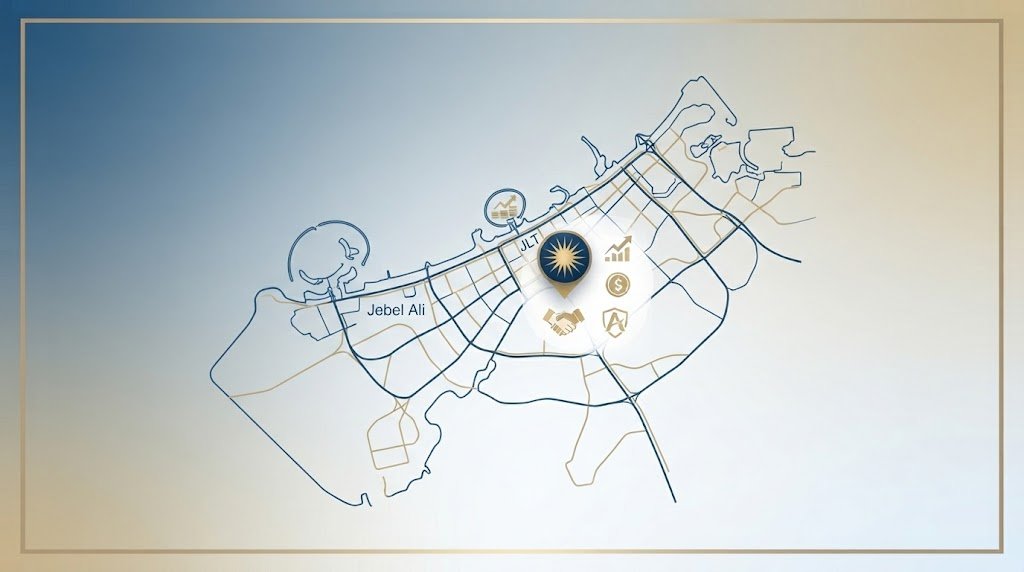
DMCC offers 100% foreign ownership, full repatriation of profits and capital with no currency restrictions, and access to premium office infrastructure including the Almas Tower and Uptown Dubai. It’s not the cheapest free zone — government fees, office costs, and visa charges tend to run higher than average — but it’s a strong fit for businesses that value a globally recognised address, banking credibility, and an active professional network over minimum setup cost.
Key advantages include:
- Full ownership without a local UAE sponsor
- Unrestricted profit and capital repatriation
- A strategic JLT location close to Dubai Metro, Sheikh Zayed Road, Dubai International Airport, Al Maktoum International Airport, and Jebel Ali Port
- A wide range of licensable activities across trading, technology, consulting, manufacturing, and more
- Flexible office solutions, from shared desks to full commercial floors
- Eligibility to sponsor UAE residence visas for owners, staff, and family
- No personal income tax, plus potential eligibility for 0% corporate tax under the Qualifying Free Zone Person regime
- A large, active business community with regular networking and investment events
Who Should Set Up in DMCC
DMCC suits a broad range of business types:
- Startups and entrepreneurs in tech, fintech, digital marketing, e-commerce, or consulting who want room to scale
- SMEs looking for a credible Dubai presence without committing to a large office upfront
- International companies using Dubai as a regional base for the Middle East, Africa, or South Asia
- Trading and commodities businesses, DMCC’s original specialty — gold, diamonds, precious metals, agricultural goods, and general trade
- E-commerce operators who benefit from the UAE’s logistics and payments infrastructure
- Professional service providers — consultants, agencies, engineers, and financial advisors
- Technology and innovation companies, including software, AI, blockchain, and SaaS businesses
- Light manufacturers, for assembly, packaging, and processing activities
- Investors seeking UAE residency through company ownership
If your only goal is the cheapest legal Dubai address, other free zones will typically cost less. DMCC earns its premium through reputation and infrastructure.
Business Activities and Industries

DMCC licenses activities across a wide span of sectors, including general trading, commodities (gold, diamonds, precious metals, agricultural products), IT and software, e-commerce, consulting and professional services, financial and corporate support services, light manufacturing, logistics, healthcare-adjacent trading and consulting, education and training, media and creative services, real estate support services, and sustainability-focused businesses. Many of these activities can be combined under a single license where DMCC’s rules allow, and additional activities can usually be added later through a license amendment.
Company Structures
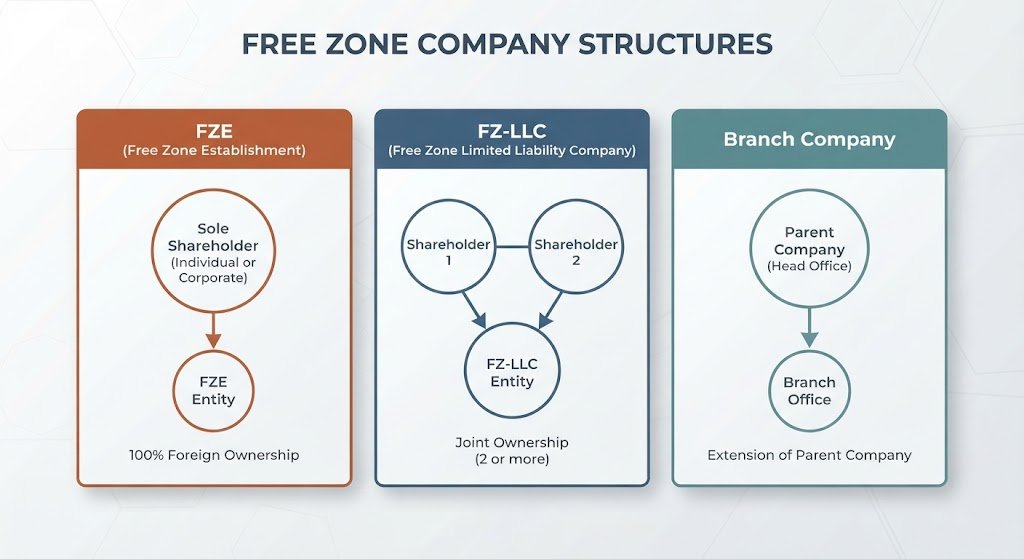
There are three legal entity structures available:
Free Zone Establishment (FZE) — A single-shareholder company, where the shareholder can be an individual or a corporate entity. It has its own legal personality, so liability is limited to the company’s capital. This is the simplest option when there’s only one owner.
Free Zone Limited Liability Company (FZ-LLC) — The same concept as an FZE but with two or more shareholders, who can be individuals, corporate entities, or a mix. Each shareholder’s liability is capped at their share of the capital. It’s the standard choice for partnerships and multi-investor ventures.
Branch of a Company — Not a separate legal entity, but an extension of an existing parent company (UAE-based or foreign), operating under the parent’s name and legal identity. The parent remains fully liable for the branch’s obligations, and the branch can only carry out activities within the parent’s existing licensed scope.
Separately, DMCC categorizes who is registering the company as Individual (natural persons registering directly, with personal documentation), Subsidiary (an existing company establishing a new DMCC entity, usually as an FZE or FZ-LLC, with corporate documents from the parent), or Branch (as above).
License Types Available in DMCC
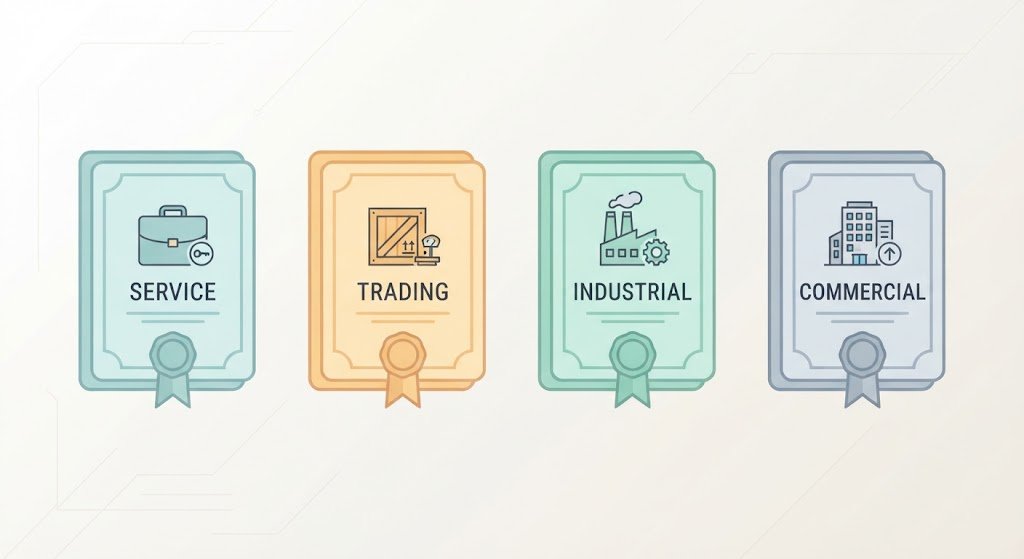
DMCC issues several license categories, each tied to a different kind of activity:
| License Type | Best For | Covers |
|---|---|---|
| Service License | Consultants, agencies, professionals | Consultancy, IT, marketing, accounting, training, design |
| Trading License | Importers, exporters, wholesalers | Buying, selling, importing, exporting, and storing approved product categories |
| General Trading License | Multi-product trading companies | Trading across a broader range of product categories under one license, usually at a higher fee than a standard trading license |
| Commercial License | Holding companies, SPVs, family offices | Approved commercial and corporate holding activities |
| Industrial License | Manufacturers and producers | Light manufacturing, assembly, processing, and packaging |
Choosing the right license depends on whether you’re trading physical goods or offering services, your target market, and your growth plans — getting it right at the outset avoids amendment costs later.
DMCC Step-by-Step Setup Process
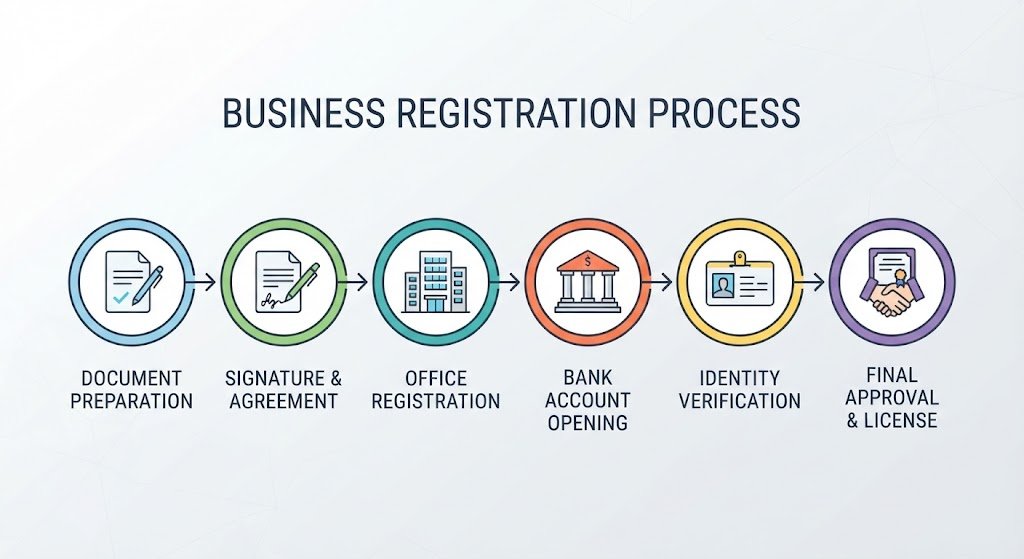
- Choose your business activity and legal structure. This decision sets your license category and entity type.
- Reserve your company name and submit the initial application. Regulated activities go through stricter naming checks, which can add time.
- Prepare and submit your documents. See the checklist below.
- Sign incorporation documents and select your office space. DMCC’s minimum requirement is a flexi-desk.
- Register through the DMCC portal and pay government fees. Once approved, you receive your certificate of incorporation, trade license, establishment card, and share certificates (for FZE/FZ-LLC).
- Open a corporate bank account.
- Process residency visas for owners, employees, and eligible dependents.
- Register with the Federal Tax Authority for corporate tax and VAT as applicable.
DMCC’s digital pathway — online pre-approval, payment and document signing through the portal, then office selection — typically issues an E-license within around 10 working days of document completeness. Some setup consultancies quote 3–5 working days for licensing alone once paperwork is finalised, with visas and bank account opening adding another 2–4 weeks.
Documents Required for DMCC Company Setup
For individual shareholders:
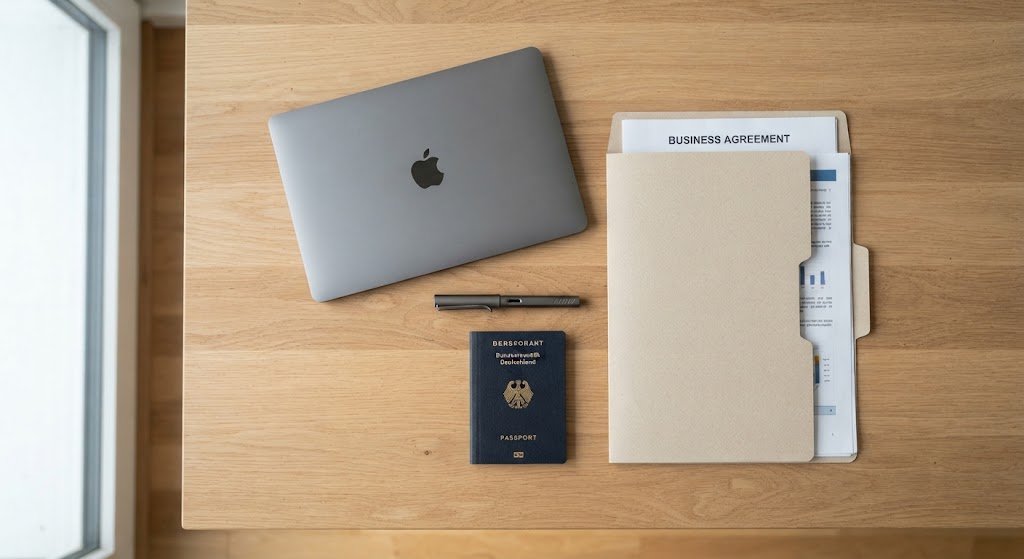
- Valid passport copy (minimum 6 months’ validity) for each shareholder, director, and manager
- UAE visa and Emirates ID copies, where applicable
- Recent passport-size photograph
- Proof of residential address (utility bill, bank statement, or tenancy contract issued within the last 6 months)
- Completed application form and a few proposed company name options
For corporate shareholders:
- Certificate of incorporation and trade license of the parent company
- Memorandum and Articles of Association
- Board resolution authorising the DMCC investment and naming an authorised signatory
- Certificate of incumbency or good standing, where applicable
- UBO (Ultimate Beneficial Owner) declaration
- Passport copies and proof of address for authorised signatories
For branch offices, add the parent company’s incorporation and license documents, a board resolution approving the branch, and confirmation that the branch’s activities fall within the parent’s licensed scope.
Some activities require extra documentation — a business plan, professional qualifications, or regulatory no-objection certificates. Foreign-issued corporate documents may need notarisation or legalisation before submission. Keeping names consistent across all documents and using recent, legible scans speeds up approval.
Office Options for DMCC Company Setup

Every DMCC company must maintain a registered physical address within the free zone. Options include:
- Flexi-desk — the most affordable entry point, popular with startups and freelancers; shared workspace with an official DMCC address
- Serviced desk — a dedicated workstation in a shared office, suited to small teams
- Serviced office — a fully furnished private office, ready for immediate use
- Private office — exclusive leased space that can be customised, suited to established SMEs
- Commercial office space — larger units in DMCC’s towers, for bigger teams or regional headquarters
- Retail units and warehouses — for customer-facing or industrial/logistics businesses
Your office type also influences your visa quota — larger, dedicated spaces generally support more visa allocations than a shared flexi-desk, though exact numbers are set by DMCC and current UAE immigration policy, so confirm quotas directly with DMCC or a licensed agent rather than relying on older published figures.
Visa Eligibility for DMCC
A DMCC company with an active license and establishment card can sponsor UAE residence visas for owners, shareholders, employees, and eligible dependents. Broad categories include:
- Investor/shareholder visas for business owners, based on ownership structure
- Employment visas for directors, managers, and staff, processed through the DMCC portal
- Family sponsorship for spouses, children, and in some cases parents, once income and immigration conditions are met
The standard process involves applying through the DMCC portal, securing an entry permit where needed, completing a medical fitness test, applying for an Emirates ID, and arranging health insurance before the residence visa is issued. Companies that outgrow their standard visa quota can apply for an exceptional quota increase, generally subject to having an active license, a physical (non-shared) office, and good compliance standing.
Cost of Setting Up in DMCC (2026)
Costs vary depending on what’s bundled in. Rough current ranges:
- License fee alone: roughly AED 7,500–35,000, depending on activity and license type
- Virtual office package: AED 19,500–23,500 (typically one visa)
- Flexi-desk package: AED 24,500–29,500 (typically two visas)
- Executive/serviced office: AED 45,000–90,000+, visa quota scaling with space
- Visa government fees: roughly AED 4,000–6,000 per person
- Realistic first-year total: most estimates land around AED 35,000–55,000+, with some quoting a practical minimum near AED 50,000 once a flexi-desk, one or two visas, Emirates ID, and medical testing are all included
The license fee alone is rarely the full picture — always request a current written quote for your specific activity and structure before budgeting.
Corporate Tax and Compliance
The UAE’s standard corporate tax rate is 9% on taxable profits above AED 375,000. DMCC companies may qualify for a 0% rate as Qualifying Free Zone Persons (QFZPs), but only if they meet substance and qualifying-income conditions — it isn’t automatic, and there’s no blanket exemption. Companies that don’t meet QFZP criteria are taxed at the standard 9% rate on profits above the threshold.
Other compliance requirements:
- Mandatory annual audit — DMCC requires this of all registered companies, which is stricter than many other UAE free zones
- UBO reporting — companies must maintain and update Ultimate Beneficial Owner information for anyone holding 25% or more ownership or control, under UAE AML/CFT rules
- VAT registration — required once turnover crosses the mandatory threshold
How Dubai Multi Commodities Centre (DMCC) Compares
Choosing between free zones? Here’s how DMCC stacks up against the two most commonly compared alternatives.
| Feature | Dubai Multi Commodities Centre (DMCC) | Jebel Ali Free Zone (JAFZA) | International Free Zone Authority (IFZA) |
|---|---|---|---|
| Primary Focus | Commodities, trading, tech, crypto, professional services | Logistics, manufacturing, large-scale trading | General/multi-sector, startups, SMEs |
| 100% Foreign Ownership | Yes* | Yes* | Yes* |
| 0% Tax on Qualifying Income (QFZP) | Subject to UAE corporate tax rules and qualifying conditions | Subject to UAE corporate tax rules and qualifying conditions | Subject to UAE corporate tax rules and qualifying conditions |
| 100% Profit Repatriation | Yes* | Yes* | Yes* |
| Approved Business Activities | 900+ | 7,500+ | 500+ |
| Crypto/Digital Asset Framework | Crypto Centre – 700+ companies | — | Available subject to applicable regulations |
| AI & Gaming Centres | AI: 110+ | Gaming: 140+ companies | — | — |
| Port & Logistics Access | Nearby – Jebel Ali Port ~20 min | Direct Jebel Ali Port access | — |
| Warehousing & Industrial Facilities | Limited | Extensive | Limited |
| Flexi-Desk Option | Available – up to 3 visas* | Available depending on package | Available |
| Registered Companies (2025) | ~26,000 | 11,472 | 20,000+ |
| Location | JLT, Dubai | Jebel Ali, Dubai | Dubai Silicon Oasis area |
| Best Suited For | Trading, crypto, tech, commodities, professional services | Manufacturing, logistics, large-scale import/export | Budget-conscious startups, freelancers, SMEs |
* Requirements, eligibility, visa limits, tax treatment, business activities and available facilities can vary. Always verify current requirements with the relevant free zone authority and UAE authorities before establishing a company.
Is DMCC Right for You?
DMCC makes sense if you want a globally recognised JLT address, plan to work with international banks and counterparties that value reputation, or operate in trading, commodities, or professional services where DMCC’s network adds real commercial value. If your only priority is the lowest possible setup cost and you don’t need a premium address or physical presence, a lower-cost free zone will likely serve you better.