
Corporate Tax Services for UAE Businesses
VAZONE provides corporate tax support for businesses in Dubai and across the UAE. Our services cover registration, tax assessment, return preparation, compliance reviews, and ongoing advisory.
We help you connect your accounting records with your tax obligations, identify the rules relevant to your business, and prepare for filing deadlines. The scope depends on your legal structure, activities, transactions, and reporting requirements.
Explore our wider UAE business services or request a consultation to discuss your corporate tax requirements.
Why Do You Need Corporate Tax Services in the UAE?
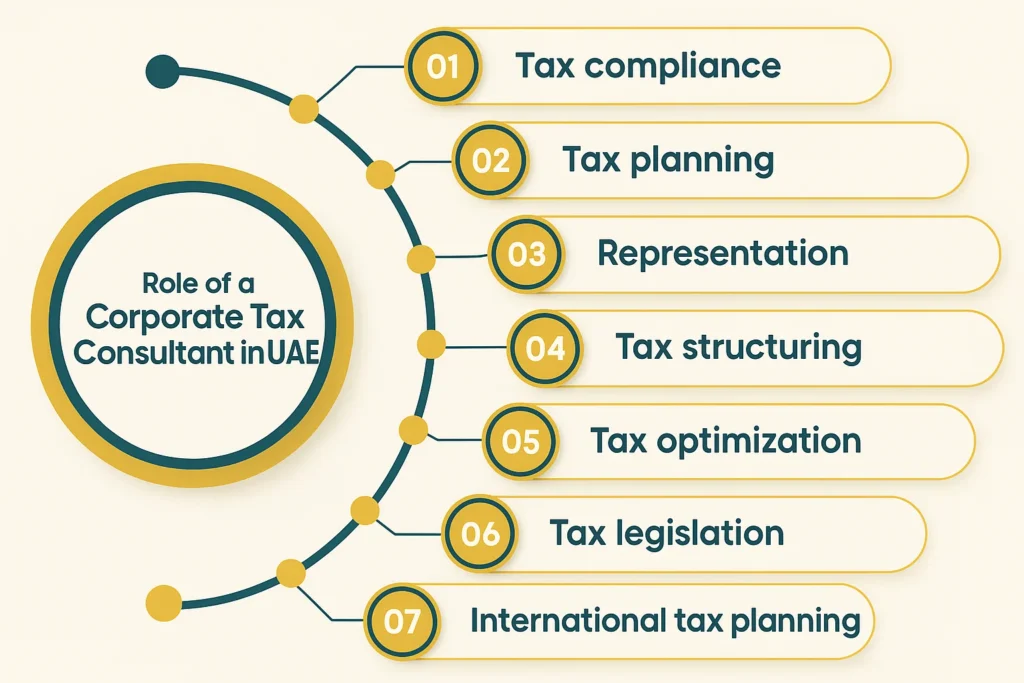
UAE federal corporate tax applies to financial years beginning on or after 1 June 2023. Businesses need to assess whether they are taxable persons, meet registration deadlines, maintain supporting records, and file the required returns.
A low tax liability does not automatically remove registration or filing obligations. Free zone companies, businesses claiming relief, and entities with related-party transactions may also need specific assessments.
Professional support helps your team understand these requirements and identify issues before a return is submitted.
Understanding UAE Corporate Tax Rates
| Category | General treatment |
|---|---|
| Standard regime: taxable income up to AED 375,000 | 0% corporate tax. |
| Standard regime: taxable income above AED 375,000 | 9% on the portion exceeding AED 375,000. |
| Qualifying Free Zone Person | 0% on qualifying income and 9% on taxable income that is not qualifying income, subject to the free zone regime’s conditions. |
| In-scope multinational groups | Separate domestic minimum top-up tax rules may apply under the Pillar Two framework. |
Example under the standard regime: If a company has AED 500,000 of taxable income, the first AED 375,000 is taxed at 0%. The remaining AED 125,000 is taxed at 9%, producing AED 11,250 of corporate tax before any applicable reliefs or credits.
Multinational top-up tax: The UAE’s domestic minimum top-up tax applies for financial years starting on or after 1 January 2025 to in-scope UAE entities of multinational groups. The revenue test is EUR 750 million or more in at least two of the four preceding financial years. It operates through a minimum effective tax framework, rather than replacing the standard corporate tax rate with a flat 15% rate for every business.
Review the official UAE corporate tax guidance and multinational top-up tax framework for the relevant rules.
Benefits of Professional Corporate Tax Support
- Accurate assessment: Review accounting income, tax adjustments, deductions, exemptions, and available credits.
- Practical tax planning: Assess eligible reliefs and commercial structures within the law.
- Clear compliance processes: Organise registrations, records, returns, and payment responsibilities.
- Reduced risk of avoidable errors: Identify missing information and inconsistent classifications before filing.
- Better business decisions: Consider the tax implications of restructuring, investments, and cross-border transactions.
Our tax compliance services can also support businesses managing several tax reporting obligations.
All-in-One Corporate Tax Solutions in UAE
Corporate tax support should reflect how your business operates. VAZONE can help review the following areas under Federal Decree-Law No. 47 of 2022, as amended, and its relevant implementing decisions.
1. Legal Framework and Scope
Understand the definitions, applicable rules, tax periods, and obligations relevant to your entity and activities.
2. Applicable Corporate Tax Rates
Assess the standard rates, any applicable special regime, and whether multinational top-up tax requires a separate review.
3. Exempt Persons
Review whether an entity meets the conditions for exemption. Exemption depends on the relevant category and may require an application, listing, or other formal conditions.
4. Taxable Persons and Tax Base
Assess resident and non-resident status, branches, permanent establishments, and other relevant connections to determine the scope of taxation.
5. Free Zone Corporate Tax
Review Qualifying Free Zone Person status, qualifying income, substance, audit obligations, and other conditions. A free zone licence alone does not guarantee a 0% rate.
6. Taxable Income Calculations
Start with accounting income and assess the adjustments required for expenses, exempt income, transactions, and other tax treatments.
7. Exempt Income
Review whether dividends, participation gains, or foreign permanent establishment income qualify for exemption. These categories are not automatically exempt in every case.
8. Reliefs and Incentives
Assess eligibility for Small Business Relief, business restructuring relief, qualifying group relief, and relevant exemptions. Elections, thresholds, exclusions, and supporting conditions must be considered.
9. Deductible Expenses
Review business expenses, interest limitations, entertainment restrictions, and non-deductible items. Accounting recognition does not always mean an expense is fully deductible for tax.
10. Related Parties and Connected Persons
Assess whether transactions meet the arm’s-length standard and whether connected-person payments satisfy the applicable deduction conditions.
11. Tax Losses
Review available losses, carry-forward requirements, utilisation limits, and any eligibility for transferring losses between qualifying entities.
12. Tax Group Formation
Assess ownership and other eligibility conditions before applying to form a tax group. An approved corporate tax group is generally treated as a single taxable person for corporate tax purposes.
13. Corporate Tax Payable
Calculate the liability after relevant adjustments, reliefs, exemptions, and eligible credits, and reconcile the calculation to the return.
14. Payments and Refunds
Plan tax payments and assess eligible refund claims. Keep payment references, confirmations, and supporting calculations with your tax records.
15. Transfer Pricing Documentation
Assess applicable disclosures and documentation requirements. Master File and Local File obligations apply when the relevant thresholds and conditions are met; they are not mandatory for every business with a related-party transaction.
16. Anti-Abuse Rules
Review arrangements for commercial substance and compliance with anti-abuse provisions. Artificial arrangements designed to obtain an improper tax advantage can be challenged.
17. Registration and Deregistration
Support corporate tax registration and review deregistration requirements when a business closes, liquidates, or otherwise meets the relevant conditions.
Read our corporate tax registration guide for an introduction to the registration process.
18. Return Filing and Clarification Requests
Prepare the required return and supporting schedules. Where a technical issue needs clarification, assess whether an FTA clarification request is appropriate.
19. Penalties and Corrective Action
Identify potential compliance gaps and review the appropriate correction, disclosure, reconsideration, or other available process. Outcomes depend on the facts and applicable rules.
20. Transitional and Opening Balance Rules
Review opening balances, historical transactions, and available transitional elections where relevant to the business and tax period.
Procedure of Corporate Tax Services in UAE
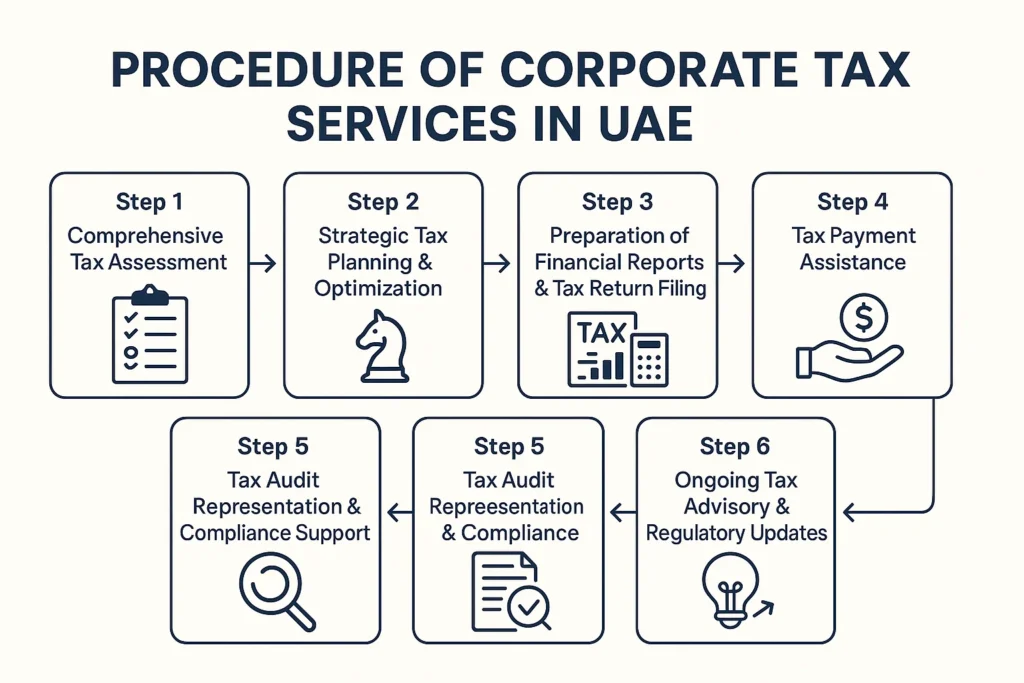
Our six-step approach connects your business information, tax assessment, and return preparation.
Step 1: Comprehensive Tax Assessment
- Review your legal structure, business model, and accounts.
- Identify taxable activities and relevant income sources.
- Review free zone, group, and related-party considerations.
- Confirm registrations, reporting periods, and deadlines.
Step 2: Tax Planning and Eligibility Review
- Assess relevant deductions, exemptions, and reliefs.
- Review tax losses and potential group arrangements.
- Consider the tax impact of planned commercial transactions.
- Document recommendations and supporting assumptions.
Step 3: Financial Records and Return Preparation
- Reconcile financial information and supporting schedules.
- Assess whether audited statements are required.
- Prepare tax adjustments and calculate taxable income.
- Prepare the return for your review and approval.
Learn more about corporate tax return filing in UAE .
Step 4: Submission and Tax Payment Support
- Support authorised submission through EmaraTax.
- Confirm the payment amount and applicable deadline.
- Retain filing and payment confirmations.
- Review eligible refunds or account balances where relevant.
Step 5: Tax Audit and Compliance Support
- Organise supporting documents for FTA requests.
- Help explain calculations and reconcile differences.
- Coordinate responses within the agreed service scope.
- Arrange any formal representation only where the appropriate authorisation requirements are met.
Step 6: Ongoing Advisory and Regulatory Updates
- Review changes relevant to your business.
- Maintain a compliance calendar for future periods.
- Support improvements to records and internal controls.
- Assess the tax implications of new transactions.
Documents and Corporate Tax Filing Deadlines
Required documents vary, but a typical preparation checklist includes:
- Trade licence and company registration documents.
- Corporate tax registration details.
- Financial statements, trial balance, and general ledger.
- Bank reconciliations and relevant transaction records.
- Income and expense breakdowns.
- Fixed asset and depreciation schedules.
- Related-party and connected-person transaction details.
- Supporting calculations for reliefs, losses, and credits.
- Prior returns and relevant FTA correspondence.
General filing deadline: Taxable persons generally must file their corporate tax return within nine months after the end of the tax period. The same deadline generally applies to payment of the corporate tax due. Registration deadlines are separate.
Confirm your reporting period and deadlines in EmaraTax. Do not assume that no tax payable means no return is required.
Why Following a Structured Procedure Matters
A consistent process helps your business identify missing information early, support its tax position, and maintain a clear record of calculations and approvals.
- Reduce avoidable errors and missed deadlines.
- Assess reliefs and exemptions before filing.
- Keep supporting records easier to retrieve.
- Improve preparation for regulatory questions.
- Plan for upcoming tax payments.
Corporate Tax Advisory in UAE
Every business has different activities, ownership, transactions, and commercial goals. Corporate tax advice should reflect those circumstances.
VAZONE works with your team to review the tax impact of current operations and planned decisions, helping you identify obligations and practical next steps.
Our Advisory Support Can Include
- Corporate tax registration and compliance guidance.
- Free zone status and qualifying income assessments.
- Tax return preparation and supporting schedules.
- Review of reliefs, exemptions, and group arrangements.
- Related-party transaction and documentation reviews.
- Tax implications of restructuring and expansion.
- Compliance process improvements and team guidance.
For wider financial requirements, explore our banking and financial advisory services .
Why Choose VAZONE for Corporate Tax Support?
- Business-specific scope: Support based on your activities, records, and reporting requirements.
- Clear explanations: Practical guidance that helps your team understand the required actions.
- Coordinated preparation: A structured approach to document collection, review, approval, and submission.
- Ongoing support: Assistance beyond the initial registration or return, according to the agreed engagement.
Learn more about VAZONE and discuss the scope suitable for your business.
Related Services and Guides
Need Help With Corporate Tax in UAE?
Discuss your registration, return filing, assessment, or advisory requirements with VAZONE. We can review your situation and agree on a suitable scope of support.
Frequently Asked Questions – Corporate Tax Services in Dubai, UAE
What do corporate tax services include?
Corporate tax services can include registration, assessment of taxable income, return preparation, relief and exemption reviews, transfer pricing support, and ongoing compliance advice. The scope depends on your business and agreed engagement.
What is the standard UAE corporate tax rate?
Under the standard regime, 0% applies to taxable income up to AED 375,000 and 9% applies to the portion above AED 375,000. Special rules apply to Qualifying Free Zone Persons and certain multinational groups.
When must a corporate tax return be filed?
Taxable persons generally must file their return within nine months after the end of the relevant tax period. The same deadline generally applies to payment of any corporate tax due. Registration deadlines are separate.
Do free zone companies automatically pay 0% corporate tax?
No. A company must meet the conditions for Qualifying Free Zone Person status to benefit from 0% on qualifying income. Other taxable income is subject to the relevant rules. A free zone licence alone does not guarantee the 0% treatment.
Must a business file a return if no corporate tax is payable?
A taxable person may still have registration and return filing obligations even when no corporate tax is payable. A 0% rate or a relief claim does not automatically remove those obligations.
Does every business need a transfer pricing Master File and Local File?
No. Master File and Local File requirements depend on the applicable thresholds and conditions. However, arm’s-length rules and other disclosure or supporting documentation requirements may still apply to related-party transactions.
Are audited financial statements required for every corporate tax return?
No. Audit requirements depend on the applicable corporate tax rules and any other relevant legal or licensing requirements. Businesses should assess their circumstances, including revenue, free zone status, and group arrangements.
Does the 15% minimum tax apply to every UAE company?
No. The UAE domestic minimum top-up tax concerns in-scope entities of multinational groups meeting the EUR 750 million revenue test in at least two of the four preceding financial years. It applies for financial years beginning on or after 1 January 2025 and follows a minimum effective tax framework.
How much do corporate tax services cost?
Fees depend on your entity structure, transaction volume, accounting records, tax complexity, and required support. VAZONE can review your requirements and quote for an agreed scope of work.
Can VAZONE help with registration and return filing?
VAZONE can support corporate tax registration, document preparation, tax calculations, and authorised return submission. Your business should review and approve information before it is submitted.