
VAZONE Expert Guide
DMCC FZE vs FZ-LLC: What’s the Difference?
Understanding the difference between DMCC FZE vs FZ-LLC is important when choosing a company structure in Dubai. The main distinction traditionally relates to the number of shareholders and ownership structure. This guide explains FZE, FZ-LLC, and branch structures, including ownership, liability, setup requirements, and key differences.
Get in touch
Table of Contents
DMCC FZE vs FZ-LLC: Complete Guide to Company Structures in Dubai
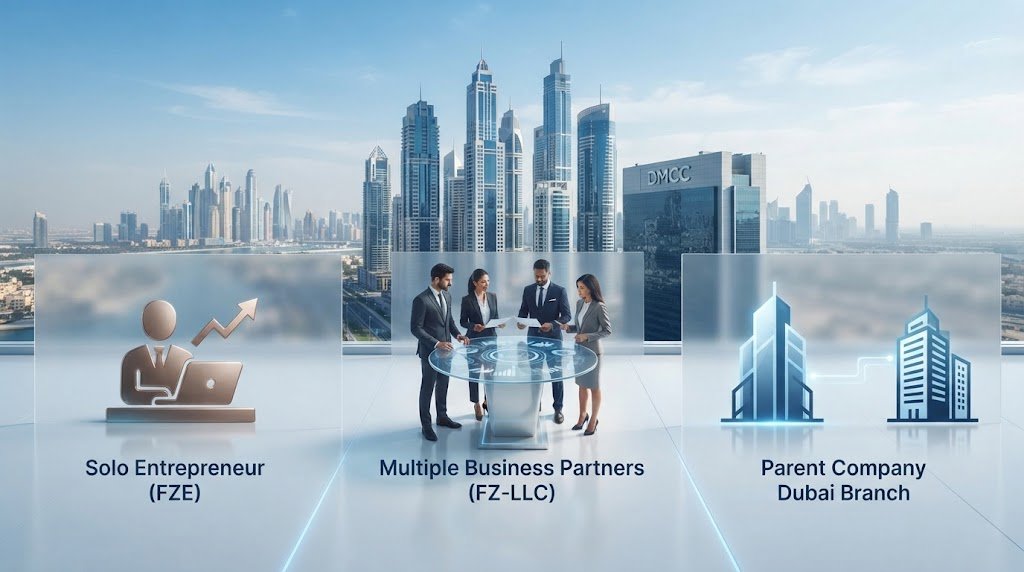
Choosing the right legal structure is an important part of setting up a company in Dubai. Entrepreneurs researching DMCC FZE vs FZ LLC often want to understand the difference between a Free Zone Establishment and a Free Zone Limited Liability Company, including ownership, liability, shareholders, setup requirements, and ongoing operations.
DMCC has evolved its company-formation framework over time, so terminology can sometimes be confusing. The terms FZE and FZ-LLC have historically been used for different ownership structures, while newer DMCC materials and company records also use FZCO terminology. Therefore, applicants should confirm the exact legal form available for their proposed setup with DMCC before incorporation.
This guide explains the practical differences and helps business owners understand which structure may fit their ownership arrangement.
What Is a DMCC FZE?
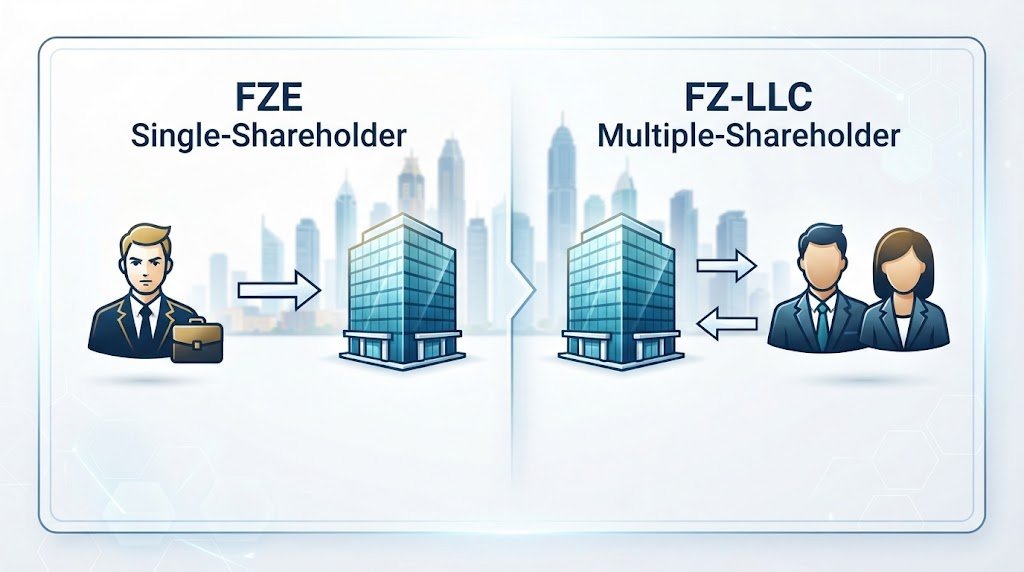
FZE stands for Free Zone Establishment.
Traditionally, an FZE refers to a free-zone company with a single shareholder. Depending on the applicable free-zone rules, the shareholder may be an individual or a corporate entity.
The FZE structure is generally associated with entrepreneurs who want to establish a company with one owner rather than multiple shareholders.
However, it is important not to assume that every current DMCC application will be registered under the FZE name. DMCC’s current setup information uses broader formation categories, while historical and existing DMCC company records include FZE names.
What Is a DMCC FZ-LLC?
FZ-LLC stands for Free Zone Limited Liability Company.
The term has traditionally been used for a free-zone limited liability structure, particularly where there are multiple shareholders.
A DMCC company is a separate legal entity governed by DMCC’s applicable company regulations and its constitutional documents. DMCC’s company framework provides for shareholders, share capital, Articles of Association, and company governance requirements.
DMCC records also contain companies using the FZ-LLC designation, demonstrating that the terminology has been used for companies registered in the free zone.
DMCC FZE vs FZ-LLC: Key Difference
The traditional distinction between an FZE and an FZ-LLC is primarily related to the number of shareholders.
| Feature | FZE | FZ-LLC |
|---|---|---|
| Traditional meaning | Free Zone Establishment | Free Zone Limited Liability Company |
| Typical ownership | Single shareholder | Multiple shareholders |
| Shareholder type | Individual or corporate, subject to applicable rules | Individuals and/or corporate shareholders, subject to applicable rules |
| Liability | Limited to the company structure/share capital | Limited to the company structure/share capital |
| Separate legal entity | Yes, where established as a company | Yes |
| Suitable ownership model | Single-owner business | Joint ownership/business with multiple shareholders |
| DMCC terminology | Historical/existing terminology | Historical/existing terminology |
| Current application terminology | Confirm with DMCC | Confirm with DMCC |
The most important point is that FZE vs FZ-LLC should not be treated as a simple one-size-fits-all choice in 2026. DMCC’s current company setup framework has evolved, and applicants should use the legal structure offered for their specific application.
Is an FZE a Single-Owner Company?
Traditionally, yes.
An FZE is generally understood as a free-zone establishment with one shareholder. This makes the structure relevant to an entrepreneur who wants to own the business alone.
For example, suppose an entrepreneur wants to establish a consulting company in DMCC and does not have a business partner or co-investor. A single-shareholder structure may be appropriate, subject to DMCC’s current formation rules and the selected business activity.
The important distinction is ownership rather than the business activity itself.
Is an FZ-LLC for Multiple Shareholders?
Traditionally, an FZ-LLC is associated with a company having multiple shareholders.
For example, two entrepreneurs could establish a business together, with each holding shares according to their agreed ownership arrangement.
Corporate shareholders may also be relevant where an existing company establishes or owns a DMCC entity, subject to DMCC’s applicable requirements.
DMCC’s current formation framework specifically distinguishes between individual and subsidiary formation routes, while its regulations and documentation address shareholder and ownership requirements.
FZE vs FZ-LLC: Ownership
Ownership is one of the first factors to consider.
FZE
Under the traditional FZE model, the company has one shareholder.
That shareholder may be:
- An individual
- A corporate entity
The exact permitted ownership arrangement should be confirmed with DMCC for the proposed application.
FZ-LLC
The traditional FZ-LLC model is used for shared ownership.
This may be relevant when:
- Two or more founders are establishing a company
- Investors are participating in the business
- A company is establishing a subsidiary
- Ownership needs to be divided between shareholders
DMCC’s current setup documentation includes separate guidance for individual and subsidiary setups, reflecting the different documentation requirements that can apply depending on ownership.
FZE vs FZ-LLC: Liability
Both terms refer to limited-liability company structures rather than branches.
A properly incorporated company is a separate legal entity from its shareholders. DMCC’s company framework provides for companies to have their own constitutional documents and share capital.
This distinction is important when comparing a company with a branch.
A branch is generally an extension of an existing parent company rather than a separate subsidiary company. DMCC has a separate process and documentation requirements for opening a branch.
FZE vs FZ-LLC: Business Activities
The legal structure and the business activity are separate considerations.
For example, a company may be involved in:
- Trading
- Consulting
- Technology
- E-commerce
- Professional services
- Media
- Commodities
- Other approved activities
The appropriate licence depends on the activity the company intends to conduct.
Therefore, choosing between an FZE and FZ-LLC does not by itself determine whether you can conduct a particular activity. The activity must be approved and included within the company’s licence.
DMCC provides an approved activities list and licensing rules as part of its company setup resources.
FZE vs FZ-LLC: Setup Requirements
The exact requirements depend on the proposed company structure, ownership, and activity.
Common requirements may include:
- Passport copies
- Shareholder information
- Director information
- Authorised signatory information
- Proof of address
- Proposed company name
- Business activity information
- Ownership details
- Memorandum and Articles of Association
- Corporate documents for corporate shareholders
- Other documents requested by DMCC
DMCC states that company formation can be completed through its online portal, with documentation requirements varying according to the type of formation.
FZE vs FZ-LLC: Company Name
Company naming is another area where applicants should be careful.
DMCC has specific company-name requirements and a restricted names list. Its naming rules have also changed over time, so older articles may contain outdated information.
For this reason, businesses should check the current DMCC naming requirements before submitting an application.
It is also worth noting that DMCC announced a new naming convention for free-zone members in 2025, replacing the legacy “DMCC” suffix approach for greater clarity and consistency.
FZE vs FZ-LLC: Share Capital
Share capital requirements can depend on the company’s structure, licence, and applicable DMCC rules.
Older guidance and third-party articles may quote specific minimum capital amounts, but these figures should not be copied into a current company-formation article without verification.
DMCC’s company regulations provide that share capital must be denominated in UAE dirhams and meet the minimum required by the Registrar from time to time.
Therefore, before establishing a company, applicants should confirm the current capital requirements directly with DMCC or through a qualified business setup adviser.
Does FZE or FZ-LLC Affect 100% Foreign Ownership?
A key benefit of establishing a company in a UAE free zone is the availability of full foreign ownership under the applicable free-zone framework.
DMCC currently promotes company formation with full ownership and a digital setup process.
However, ownership structure and legal form are separate issues.
An entrepreneur should determine:
- Who will own the company?
- Will there be one shareholder or multiple shareholders?
- Is the shareholder an individual or a company?
- What business activity will be licensed?
- What office solution is required?
- What visas will be needed?
These factors help determine the appropriate setup.
FZE vs FZ-LLC vs Branch
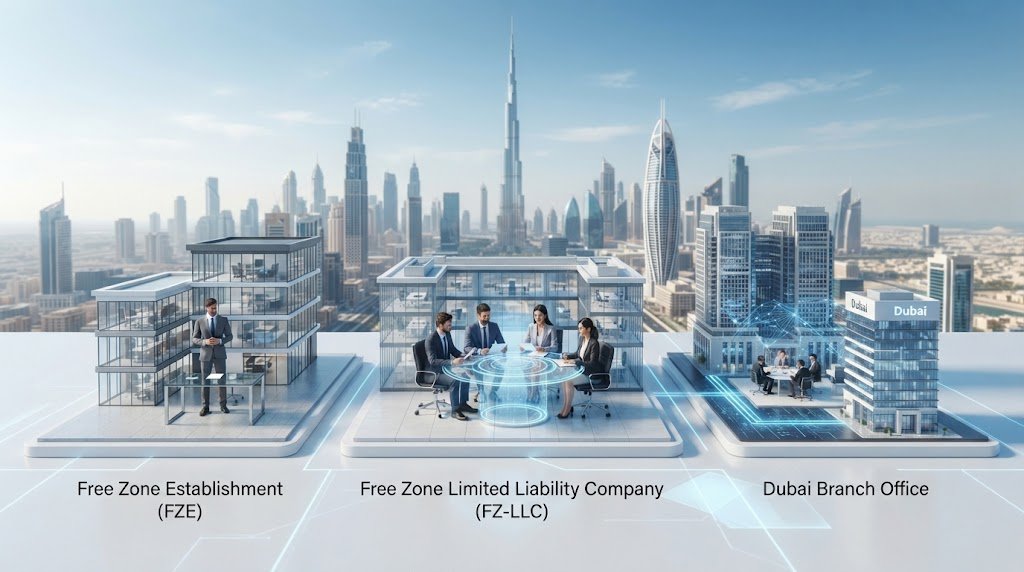
It is also useful to understand how company structures differ from a branch.
| Factor | FZE | FZ-LLC | Branch |
|---|---|---|---|
| Traditional ownership | One shareholder | Multiple shareholders | Parent company |
| Separate company | Yes | Yes | No separate subsidiary entity |
| Parent company required | Not necessarily | Not necessarily | Yes |
| Liability structure | Company | Company | Parent company relationship |
| Main purpose | Standalone business | Shared ownership business | Extension of existing company |
DMCC provides separate procedures for opening branches, including specific guidelines and documentation.
Which Structure Is Better for a Solo Entrepreneur?
For a solo entrepreneur, the traditional FZE structure may appear more straightforward because it is associated with single ownership.
However, the correct current DMCC legal form should be confirmed during the application process because DMCC’s terminology and company structures have evolved.
If you are setting up alone, tell your business setup adviser that you intend to have a single shareholder and ask which current DMCC structure applies.
Which Structure Is Better for Multiple Business Owners?
If two or more people will own the business, a multi-shareholder structure may be more appropriate.
The ownership percentage of each shareholder should be clearly documented.
For example:
- Founder A: 60%
- Founder B: 40%
The shareholders should also agree on matters such as management, decision-making, profit distribution, share transfers, and responsibilities.
A professional adviser can help ensure the ownership arrangement is properly documented.
Can a Corporate Entity Own a DMCC Company?
Yes, DMCC supports corporate ownership structures, subject to its requirements.
A subsidiary setup can involve a parent company owning the new entity. DMCC provides specific guidance and templates for subsidiary setups and corporate shareholder documentation.
This can be useful for an international company that wants to establish a separate Dubai operation rather than simply opening a branch.
Does the Structure Affect Corporate Tax?
The FZE versus FZ-LLC terminology itself does not automatically determine a company’s corporate tax treatment.
UAE corporate tax treatment depends on the applicable legislation, the company’s status, income, activities, and other conditions.
DMCC is recognised as a qualifying free zone for UAE Corporate Tax purposes. Still, the 0% rate applies to qualifying income of a Qualifying Free Zone Person subject to the applicable rules. It should not be interpreted as an automatic 0% tax rate on all income of every DMCC company.
Businesses should therefore review their specific tax position with a qualified tax adviser.
How to Choose the Right DMCC Company Structure
Before applying, consider the following questions.
1. How Many Shareholders Will There Be?
If there is only one owner, ask DMCC which current single-shareholder structure applies.
If there are multiple owners, determine the appropriate multi-shareholder structure.
2. Is the Shareholder an Individual or a Company?
The documentation can differ depending on whether the shareholder is a natural person or a corporate entity.
3. Are You Starting a New Business or Expanding an Existing Company?
A new standalone company and a branch or subsidiary can have different requirements.
4. What Is Your Business Activity?
Your chosen activity affects the licence and may influence the documents, approvals, and office requirements.
5. Will You Need Visas?
Your office solution and company setup should be planned around your expected staffing and visa requirements.
6. Do You Need a Parent-Company Structure?
If an existing international company will own the Dubai operation, compare the subsidiary and branch routes before applying.
Common Mistakes When Choosing a DMCC Legal Structure
Using Outdated Information
One of the biggest problems with UAE company-formation content is that legal structures and naming conventions can change.
Always check the latest DMCC rules before relying on information published several years ago.
Confusing Legal Structure With Licence Type
An FZE or FZ-LLC is a company structure.
Trading, service, and other licences relate to the business activities the company is authorised to conduct.
They are not the same thing.
Choosing a Structure Before Defining Ownership
First determine who will own the company and in what proportions.
Then identify the applicable legal structure.
Ignoring Corporate Shareholders
If another company will own the DMCC entity, additional corporate documents may be required.
Assuming Tax Is Automatically 0%
Free-zone tax benefits depend on the applicable UAE Corporate Tax rules and qualifying-income conditions.
How VA Zone Can Help With DMCC Company Setup

Choosing the right legal structure is only one part of establishing a business in Dubai.
The complete process can involve:
- Business activity selection
- Company structure
- Trade name
- Licence application
- Documentation
- Office solution
- Visa requirements
- Banking
- Tax registration
- Ongoing compliance
If you are comparing your options, you can learn more in our complete guide to DMCC free zone company setup in Dubai.
The guide covers the broader DMCC company-formation process and provides a useful starting point before you begin your application.
Frequently Asked Questions
Is an FZE the same as an FZ-LLC?
No. Traditionally, an FZE refers to a single-shareholder free-zone establishment, while FZ-LLC refers to a limited-liability free-zone company traditionally associated with multiple shareholders. However, DMCC’s current company-formation framework and naming conventions have evolved, so applicants should confirm the current legal form with DMCC.
Can one person own a DMCC company?
DMCC’s current formation framework includes an Individual setup route. The exact legal form and documentation depend on the proposed company and should be confirmed during the application process.
Can a company own a DMCC company?
Yes. DMCC provides a subsidiary setup route and documentation for corporate ownership.
Does an FZE have limited liability?
An FZE is traditionally a limited-liability free-zone company structure. The exact legal rights and obligations are governed by the applicable DMCC regulations and company documents.
Is FZ-LLC still used in DMCC?
FZ-LLC terminology appears in existing DMCC company records, while newer DMCC materials also use FZCO terminology. Because naming conventions have changed, applicants should confirm the legal form and suffix applicable to a new registration.
What is the difference between a DMCC company and a branch?
A DMCC company is a separate legal entity, while a branch is an extension of its parent company. DMCC has separate setup procedures for branches.
Does choosing FZE or FZ-LLC determine my business licence?
No. The company structure and business licence are separate considerations. Your licence depends on the activities you intend to conduct.
Can foreigners own a DMCC company?
DMCC currently promotes full business ownership for its company setup framework, subject to the applicable rules and requirements.
Conclusion
The traditional difference in DMCC FZE vs FZ LLC comes down primarily to ownership structure: an FZE has historically been associated with a single shareholder, while an FZ-LLC has traditionally been associated with multiple shareholders.
However, entrepreneurs should be careful when relying on older terminology. DMCC’s company-formation framework has developed, and current DMCC materials use newer formation categories and FZCO terminology alongside records containing older FZE and FZ-LLC names.
The right approach is to start with your ownership structure, business activity and company requirements, then confirm the applicable legal form with DMCC before submitting your application.
For a complete overview of the process, requirements, and other considerations, read VA Zone’s DMCC free zone company setup in Dubai guide.